
Why Most AI Charting Software Falls Short in Today’s Dental Environment
For decades, SOAP notes have been the standard framework for clinical documentation across healthcare. Subjective, Objective, Assessment, and Plan offer a simple and familiar structure for recording patient encounters. This structure has also emerged as the default format for most AI-powered charting tools on the market today.
But in dentistry today, familiarity does not always align with current legal expectations.
Given charting deficiencies are the top cause of board citation, many practices are discovering that SOAP-style charting often fails to capture the details that matter most when records are reviewed after the fact.
This gap is not about clinical quality. It is about how clinical decisions are recorded.
The core limitation of SOAP notes in dentistry
SOAP notes were designed to document medical encounters, not the procedural, multi-step, risk-driven nature of modern dental care.
In dental board cases and audits, reviewers are rarely asking:
- “Was there a note?”
They are asking:
- “Does the record clearly explain why this treatment was appropriate for this patient at this time?”
SOAP notes often fall short because they:
- Encourage generic language
- Compress complex treatment reasoning into a single “Assessment”
- Fail to consistently document alternatives, risks, and patient understanding
- Prioritize structure over clarity and completeness
The result is documentation that may feel adequate in the operatory but reads as unclear or incomplete to a third party like the dental board or a jury.
How dental boards actually evaluate records
When dental records are reviewed by a board, insurer, or attorney, the perspective is very different from day-to-day clinical use.
Reviewers look for:
- Clear diagnostic reasoning
- Evidence that alternatives were considered
- Documentation of patient communication and consent
- Consistency across visits
- A logical narrative connecting findings to treatment decisions
SOAP notes often capture what happened without fully explaining why it happened. That distinction matters.
How Lightning Dental Charts differs
Lightning Dental Charts was built specifically around how dental records are reviewed in the real world, not just how they are entered chairside. Instead of relying on a generalized SOAP framework, Lightning:
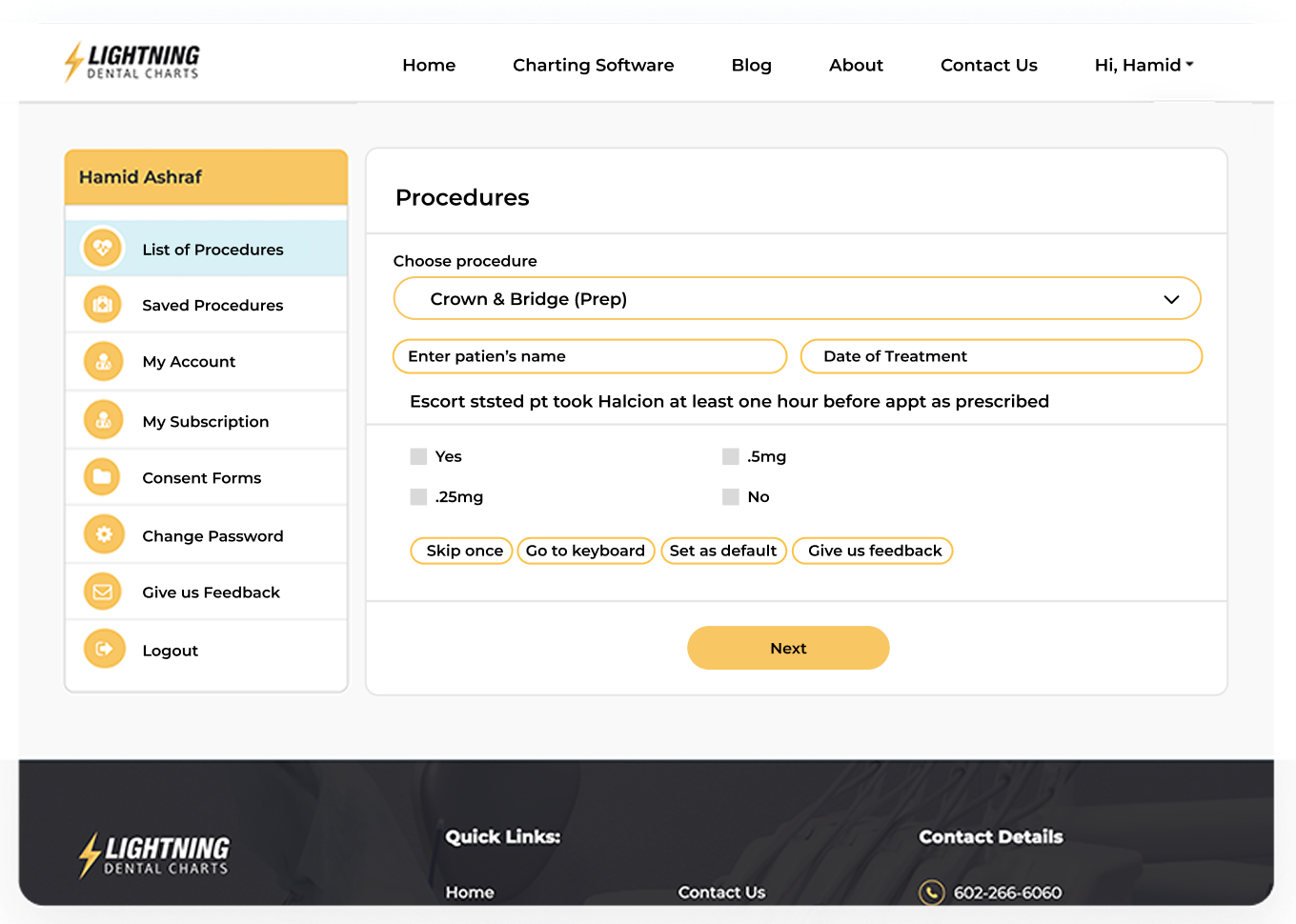
- Guides documentation step by step based on the procedure performed
- Prompts for clinical reasoning at the point of care
- Encourages consistency across providers and visits
- Structures records to tell a clear clinical story
The goal is not more documentation. It is clearer documentation that reflects sound clinical judgment.
Efficiency and clarity are not opposites
One common misconception is that better documentation requires more time. In practice, the opposite is often true. When documentation systems are designed around:
- The actual procedure
- Common decision points
- How records are later reviewed
dentists spend less time deciding what to write and more time focusing on patient care.
Lightning was designed to reduce friction while improving clarity, so charting supports dentists rather than becoming an afterthought at the end of the day.
The takeaway
SOAP notes are not inherently wrong. They are simply no longer sufficient on their own for the demands of modern dental-legal landscape.
As documentation expectations continue to evolve, practices that rely solely on traditional frameworks may find themselves exposed, not due to of subpar care, but because their records do not clearly explain clinical decisions and events.
The question for practices today is not: “Are we using SOAP notes?” It is:
“Do our records clearly explain our clinical decisions to someone who wasn’t in the room?”
That is the standard Lightning Dental Charts was built to support, continually updated by a practicing dental .
Many AI-powered charting tools on the market today simply digitize the SOAP format. They may type faster, but they still inherit the same structural limitations.
Lightning Dental Charts takes a different approach.
Rather than layering AI on top of SOAP notes, Lightning was built around how dental records are actually reviewed: guiding documentation by procedure, thoroughly recording clinical actions and reasoning, and helping records clearly reflect sound decision-making.
If you’re curious how this feels in practice, Lightning offers a 14-day free trial.
It’s an opportunity to see whether a charting system designed for clarity — not just speed — fits the way you practice.